Forgiving Forward Blog
A collection of forgiveness blogs, mission work updates, and life-giving videos and interviews that will inspire you to forgive and help others forgive.
GET ENCOURAGEMENT SENT RIGHT TO YOUR INBOX!
CELEBRATING THE LIFE OF JOHN SIPPLE
In March 2009, Dr. Bruce Wilkinson challenged us to leave the local church and carry the message of forgiveness God had given us to the church worldwide. We immediately pushed back at the suggestion because pastoring the local church was our calling and the primary reason we had not quit the ministry after all we had gone through. Dr. Wilkinson's response was, "Don't take my word for it; go ask a mentor you trust and see what they think God wants you to do." As many of you know, if you’ve heard the Forgiving Forward story, I met with Tom Rowe on March 19, 2009, who affirmed what Bruce Wilkinson was suggesting to us. Later that day, as we prayed together, Toni and I confirmed in our spirits that we were to launch what has become Forgiving Forward.
Still, at our core we were wrestling with the decision and all the logistics involved. We knew we needed help working through it, so we reached out to John and Kathie Sipple to get their counsel.
FREEDOM IS PURCHASED BY BLOOD
On July 4, 1776, 250 years ago this Saturday, during the 2nd Continental Congress, the 56 delegates from the 13 original American Colonies voted to approve and adopt the Declaration of Independence, thereby declaring themselves free from the tyrannical rule of King George of Great Britain. Drafted by Thomas Jefferson and edited by John Adams and others, the Preamble famously proclaims:
“We hold these truths to be self-evident, that all men are created equal, that they are endowed by their Creator with certain unalienable Rights, that among these are Life, Liberty and the pursuit of Happiness.”
In what is considered to be one of the most significant lines in historical literature, Jefferson declares the undeniable truth that deep within the human soul is the yearning for freedom. The Declaration of Independence formalized the American Revolutionary War, in which our founding fathers fought and died to secure our independence as a nation so as to provide the liberties and benefits we are now afforded as citizens of this great nation. Our freedom was purchased with their blood! We honor them by remembering their sacrifice and living in the freedom they purchased for us.

THE HIDDEN DANGER OF SUCCESS
We live in a culture that bombards us with demands for self-sufficiency. Self-sufficiency is the mindset that says, “I can handle this.” “Look at all I’ve done.” or “If I need God, I will give Him a call.” An elevated view of myself always comes from a low view of God.
Ben Patterson said, “We have trivialized God.” If we are honest with ourselves, we are consistently guilty of downsizing God. When we do, we invariably upsize ourselves. We have been duped into believing our own press clippings and not enough of God’s Word. Forgetting who is ultimately responsible for our success, we are seduced into believing that we are self-sufficient and we don’t need God. The consequences could not be more tragic.
In 2 Chronicles 26, we find the account of an Old Testament king who suffered the consequences of becoming self-sufficient. Uzziah was 16 years old when he became king of Judah; he ruled 52 years and “did right in the sight of the Lord.” The historian Jerome said, “The national glory of Israel died with King Uzziah and has never returned to this day.”
Uzziah was brilliant in many areas. He was a builder. He built Eloth (vs 2), cities around Ashdod (vs 6), towers in the wilderness and on the gates of Jerusalem, as well as fortified corner buttresses on the walls (vs 9-10). He was an agriculturalist; he built cisterns in the dry arid land of Israel to water his livestock, crops, and vineyards (vs 10). He was a military mastermind and inventor. According to verse 15, Uzziah was responsible for the creation of the crossbow and catapults.
SELF DENIED
Biblically, a posture is a physical position in worship that reflects the heart's attitude of reverence towards God and our dependence on Him. At the beginning of this year, the Lord impressed on us that there are six postures—six mindsets—that He wants to undergird and inform our prayers for Forgiving Forward.
All for God’s Glory
Jesus Focused
Shepherd Led
Gospel-Centric
Abiding Trust
Self Denied
This is the sixth in a series of blogs unpacking each of the postures that guide the ministry of Forgiving Forward. The sixth posture is:
Self Denied
He who has found his life will lose it, and he who has lost his life for My sake will find it.
Matthew 10:39
Could it be that the biggest challenge to God's glory and position in our lives is us? Is it possible that we have met our own worst enemy, and it’s the dude or dudette staring back at us in the mirror?
“I have now concentrated all my prayers into one, and that one prayer is this, that I may die to self, and live wholly to Him.”
Charles H. Spurgeon
At the core of the original sin in Genesis 3 was the lure of self-determination, of choosing our will over God’s will, our choice over God’s command. With two bites of the fruit, the flesh of mankind was born, which spread into the DNA of every one of Adam’s descendants, all the way down to you and me. The flesh is the spiritual force that dwells within us which is anti-God and produces sin in us. As long as our earthsuits are breathing, even after we move from death to Life in Jesus, the flesh entices us to continue to eat from the same tree our first father tasted. And we do—constantly—and everything becomes about ME, what I want, what I think I need over God’s will. It always ends with the same results—Death! Not the same spiritual death Adam and Eve experienced, but relational death. We are still God’s children, but we lose the joy of His Life in us.
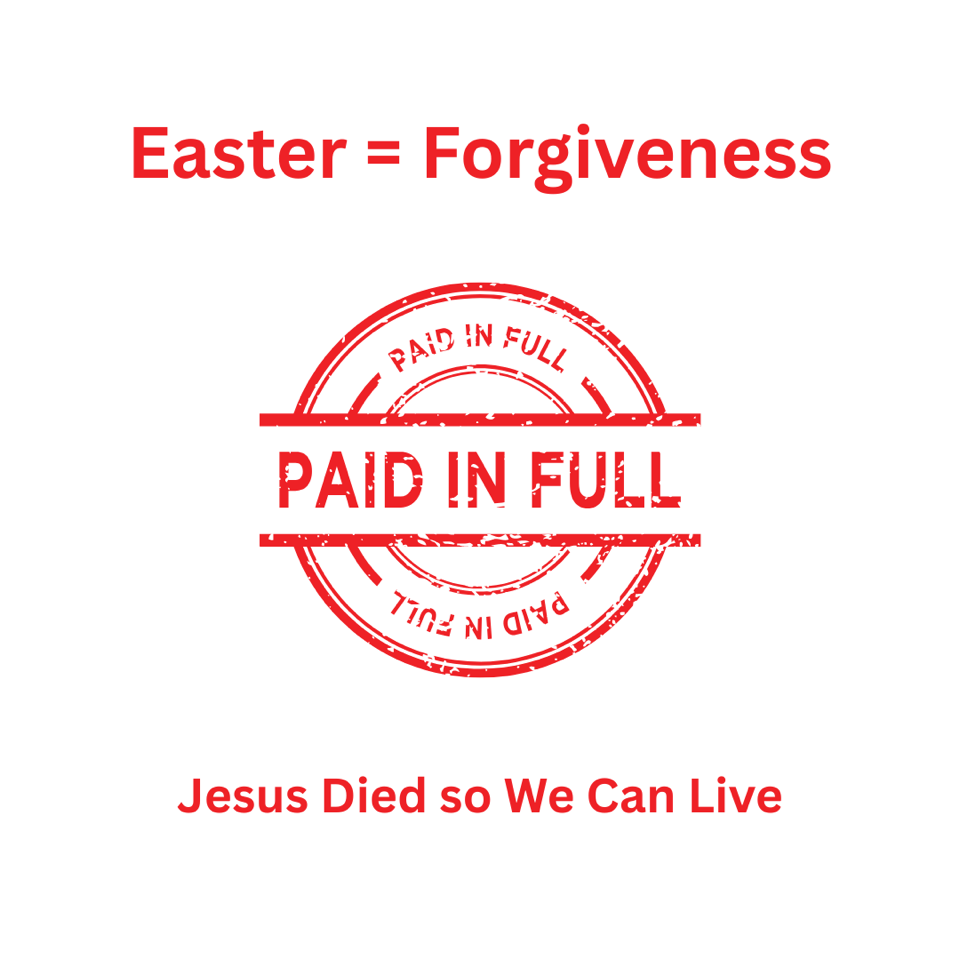
EASTER = FORGIVENESS
For I handed down to you as of first importance what I also received, that Christ died for our sins according to the Scriptures, and that He was buried, and that He was raised on the third day according to the Scriptures, and that He appeared to Cephas, then to the twelve. After that He appeared to more than five hundred brothers and sisters at one time, most of whom remain until now, but some have fallen asleep; then He appeared to James, then to all the apostles; and last of all, as to one untimely born, He appeared to me also. 1 Corinthians 15:3-8:
We are taking a pause on our series called Our Postures to celebrate the greatest event in all of history—the Death and Resurrection of Our Savior, Jesus Christ. Believers around the globe will gather together in multiple services this week to commemorate Holy Week, culminating in Resurrection Sunday. The Gospel is fully expressed and wholly contained in the Cross and the Empty Tomb.
The Gospel can be divided into two parts. First, Jesus died for our sins, and the proof that He died is that He was buried. People are buried because they are dead. Second, Jesus was raised from the dead and walked out of the tomb on the third day. The proof of the resurrection is that people saw Him. Not just Peter and the disciples, but over 500 people saw Him at one time. The resurrection of Jesus is one of the most historically attested events. That’s the Gospel. Jesus died and rose from the grave. Hallelujah!
Why did Christ die? He died for our sins. He died so that we could be forgiven.

ABIDING TRUST
Biblically, a posture is a physical position in worship that reflects the heart's attitude of reverence towards God and our dependence on Him. At the beginning of this year, the Lord impressed on us that there are six postures—six mindsets—that He wants to undergird and inform our prayers for Forgiving Forward.
All for God’s Glory
Jesus Focused
Shepherd Led
Gospel-Centric
Abiding Trust
Self Denied
This is the fifth in a series of blogs unpacking each of the postures that guide the ministry of Forgiving Forward. The fifth posture is:
Abiding Trust
I am the vine, you are the branches; he who abides in Me and I in him,
he bears much fruit, for apart from Me you can do nothing.
John 15:5
Several years ago, I heard Chip Ingram share that he had read a chapter in A. W. Tozer’s classic book The Knowledge of the Holy, which is an examination of the attributes of God, every day for over 30 years. Because I respect Chip, I was intrigued, so I decided to give it a shot. Since that time, my morning routine includes reading a chapter of Tozer’s book every day. There are 23 chapters, and when I finish chapter 23, I start over with chapter 1. I read it about 15 times a year. Why? The main reason lies in two statements Tozer makes in the book. The first line of the first chapter reads, “What comes into our minds when we think about God is the most important thing about us.” The second statement is found in the preface, “The low of God entertained almost universally among Christians is the cause of 100 lesser evils everywhere among us.” Tozer’s overarching premise is that our view of God determines and impacts everything we think, say, and do.
As I continue to saturate my mind with the attributes of God that He has revealed to us in His word, my perspectives on everything have been re-ordered and renewed. I have found that the more I get to know God, the more I find myself trusting Him more and trusting myself less. But it is a challenge, isn’t it? Here’s Tozer again, “Left to ourselves, we tend immediately to reduce God to manageable terms. We want to get Him where we can use Him, or at least know where He is when we need Him. We want a God we can, in some measure, control.” I don’t know about you, but I tend to downsize God regularly. How often do we view God as the “Heavenly Express Card,” something we keep hidden in our wallet and whip out when we need Him? The problem is that when we downsize God, we upsize ourselves, which is the root cause of most, if not all, of our troubles. The essence of idolatry, according to Tozer, is “the entertainment of thoughts about God that are unworthy of Him.” Ouch!
GOSPEL-CENTRIC
Our Postures—Part Four
As I shared in the previous blogs, Toni and I spend time together at the beginning of each year seeking God’s heart for Forgiving Forward. The key question we ask is, “Lord, what do You want us to ask You for in the coming year?” This year, as Toni and I sat together, listening and processing, God took us back to the basics so that we could codify what had been our heart posture all along. Biblically, a posture is a physical position in worship that reflects the heart's attitude of reverence towards God and our dependence on Him. The Lord gave us six postures—six mindsets—that will undergird and inform our prayers for Forgiving Forward.
All for God’s Glory
Jesus Focused
Shepherd Led
Gospel-Centric
Abiding Trust
Self Denied
This is the fourth in a series of blogs unpacking each of the postures that guide the ministry of Forgiving Forward. In the previous blogs, we discussed “All for God's Glory,” “Jesus Focused,” and “Shepherd Led.” The fourth posture is:
Gospel-Centric
For I determined to know nothing among you except Jesus Christ, and Him crucified. 1 Corinthians 2:2
One of the main concerns I have with most forgiveness models, including the one I used to follow, is that they do not address the “who pays?” question. When someone wounds us, there is a loss—something is damaged, a debt is incurred. Forgiveness requires the settling of the debt. Just choosing to forgive someone doesn’t eliminate the impact of what happened. The debt remains and must be addressed. Forgiveness simply shifts the responsibility for the debt from the one who caused it to someone else who will cover it. In most models of forgiveness, that someone else is us. Basically, intentionally or by default, we absorb the debt. We may deny it, “I’m OK, it doesn’t matter—It’s no big deal.” Or we may excuse it, “ They’re hurting. They didn’t mean to hurt me.” In either case, we absorb the unresolved debt, which will ultimately lead to bitterness and pride. “It’s not right, but look how spiritual I am!” However, in the Gospel, Jesus is the One who pays the debt. Jesus became human so that He could fully satisfy our sin debt to God by shedding His righteous blood on the Cross. Jesus, being fully God and fully human, was the only one who could pay that debt and thereby establish the basis for our forgiveness, restoring us to a relationship with God so that we could live His Life.
SHEPHERD LED
As I shared in the previous blogs, Toni and I spend time together at the beginning of each year seeking God’s heart for Forgiving Forward. The key question we ask is, “Lord, what do You want us to ask You for in the coming year?” This year, as Toni and I sat together, listening and processing, God took us back to the basics so that we could codify what had been our heart posture all along. Biblically, a posture is a physical position in worship that reflects the heart's attitude of reverence towards God and our dependence on Him. The Lord gave us six postures—six mindsets—that will undergird and inform our prayers for Forgiving Forward.
All for God’s Glory
Jesus Focused
Shepherd Led
Gospel-Centric
Abiding Trust
Self Denied
This is the third in a series of blog posts unpacking each of the postures that guide the ministry of Forgiving Forward. In the previous blogs, we discussed “All for God's Glory” and “Jesus Focused.” The third posture is:
Shepherd Led
The mind of a person plans his way, but the LORD directs his steps.
Proverbs 16:9
Most organizations and ministries spend considerable time developing their ten-year, five-year, and one-year plans, as well as their purpose, mission, and value statements. The strategy is to develop their long-term plan, then break it down into manageable action steps to get them there in the short term. So naturally, we are often asked, “What is your ministry plan?” I always answer the same way. Our ministry plan is “Savior, like a Shepherd, lead us.” That’s it! That’s all I’ve got because that’s all we need.
Don’t get me wrong, I’m OK with strategic plans. We have them, and we do use a calendar. We have a purpose statement, a passion statement, and a mission statement. They’re helpful in many ways as we lead Forgiving Forward, but they must be held loosely. We believe that the One who is the head of the ministry must be the One who guides the ministry. Jesus is the head of the ministry, and He gets to lead it. Our plan is to follow Him!
JESUS FOCUSED
As I shared in the previous blog, Toni and I spend time together at the beginning of each year seeking God’s heart for Forgiving Forward. The key question we ask is, “Lord, what do You want us to ask You for in the coming year?” This year, as Toni and I sat together, listening and processing, God took us back to the basics so that we could codify what had been our heart posture all along. Biblically, a posture is a physical position in worship that reflects the heart's attitude of reverence towards God and our dependence on Him. The Lord gave us six postures—six mindsets—that will undergird and inform our prayers for Forgiving Forward.
All for God‘s Glory
Jesus Focused
Shepherd/Spirit Led
Gospel-Centric
Abiding Trust
Self Denied
This is the second in a series of blogs unpacking each posture that guides the ministry of Forgiving Forward. In the previous blog, we discussed the first posture: “All for God’s Glory.” The second posture is:
Jesus Focused
ALL FOR HIS GLORY!
At the beginning of each year, Toni and I spend a day together seeking God’s heart for Forgiving Forward. The key question we ask is, “Lord, what do You want us to ask You for in the coming year?” The day is spent alternating between our individual times with the Lord and times spent together with Him. This is a sacred time because we never want this ministry to be about our plans or our strategies. Each year, God gives us a focus and a list of prayers He wants us to seek Him for in the coming year. We then organize these prayers into “prayer circles” that our team prays for during the coming year. We have seen God do amazing things in answering these prayers.
This year, we sensed that God wanted us to go deeper in our understanding of His purpose for Forgiving Forward and why He called us into it. As Toni and I sat together, listening and processing, we began to get clarity. God took us down to the basics so that we could codify what had been our heart posture all along. Biblically, a posture is a physical position in worship that reflects the heart's attitude of reverence towards God and our dependence on Him. The Lord gave us six postures—six mindsets—that will undergird and inform our prayers for Forgiving Forward.
All for God‘s Glory
Jesus Focused
Shepherd/Spirit Led
Gospel-Centric
Abiding Trust
Self Denied

FORGIVE FIRST!
Recently, a friend told me about a counseling course he had just completed. When they got to the subject of forgiveness, the presenter taught that one should not forgive until the offending party repents. They went so far as to say that it would be wrong to forgive someone before they repented. This is a commonly held position, and I understand why. It seems to make a lot of sense. The problem is that the Gospel message teaches the exact opposite. We don’t need to look any further than the Creation story to discover that, in God’s economy, forgiveness always precedes repentance.

Are You There, God?
Toni and I were in one of the darkest periods of our lives. In the previous four months, we had endured a campaign of slander, innuendos, and isolation, which culminated in the deepest betrayal we have ever suffered. I was broken, and both of us were discouraged, defeated, and disillusioned. We felt alone and abandoned. In desperation, we spent most of our days on our faces on the floor of our living room, crying out to God from our prayer spot.

“Do We Forgive People or Wounds?” “YES!”
Recently, we received an email with the following question: “We are having a bit of difficulty understanding the statement: ‘We don’t forgive people, we forgive wounds.’ Yet as you have taught in your protocols, we are, in fact, forgiving people—asking God who we need to forgive and then choosing to forgive these people from our heart. We are, no doubt, failing to grasp something in what you are teaching. Can you please explain further what you mean?”
THE NAMES HAVE BEEN CHANGED TO PROTECT THE FORGIVEN
Our passion here at Forgiving Forward is to help people experience the freedom of the Gospel through the power of forgiveness. There are multiple ways we work at accomplishing this, but perhaps our most effective way is through our one-on-one coaching.
Do you remember the day you accepted Christ as your Savior? Do you remember the joy you felt knowing that you had been forgiven—that Christ loved you so much that He took the penalty for your sin, and with the Holy Spirit given to you as a seal, you would never be separated from Him? (Ephesians 1:13-14) Do you remember your experience of moving from Death to Life?
In Psalm 51:12, David pleads with God, “Restore to me the joy of Your salvation.” Why would David, the one Scripture refers to as a “man after God’s own heart”, ask for that? Because David had sinned—grievously—by committing adultery and murder, and the weight of his guilt had crushed his spirit. His sin stole his joy. In Psalm 32:3–4, he reflects on that same experience: “When I kept silent, my bones wasted away through my groaning all day long.” Sin is ultimately against God, not us, but that sin deeply wounds us and robs us of joy.

FORGIVING FORWARD IN TANZANIA
Read all about Bruce and Toni’s 2025 trip to Tanzania with Here’s Life Africa.

WHEN “LOVING” ISN’T LOVE
Woe to those who call evil good, and good evil;
Who substitute darkness for light and light for darkness;
Who substitute bitter for sweet and sweet for bitter!
Woe to those who are wise in their own eyes
And clever in their own sight!
Isaiah 5:20-21
It often seems that we’re living in an alternate universe with the world upside down and spinning in the opposite direction. There has been a seismic shift in our culture as what God’s Word says is wrong is now declared right, and what God’s Word says is right is now declared wrong. How did this happen? We rise and fall on our definitions because whoever defines the terms wins the debate. We are experiencing the erosion of moral clarity as Biblical terms have been slowly unhitched from their Scriptural context and redefined in ways that don’t resemble what God intended.
A prime example of this redefinition push is the meaning of the word “love.” We are told that love requires full acceptance of a person, including their behavior, and that to reject a behavior is to reject the person and is therefore (another redefinition) “hate.” To speak against immorality is now considered hate speech. Unfortunately, Christian leaders have fallen into this trap, and the church is surrendering its authority to speak against sin in the name of love. It seems the goal of many is now to make people feel comfortable in their sin rather than leading them to repent of their sin.

THERE IS AN ANSWER TO MENTAL HEALTH ISSUES
In 1949, President Harry Truman declared May Mental Health Awareness Month to raise awareness and educate the public about mental illnesses, the realities of living with these conditions, and strategies for attaining a greater measure of mental health and wellness.. The question that begs itself is this…is it working? After 76 years of devoting a full month to the mental health of the people of our nation, one would think we are better off today than in 1949. But are we?
People all over our nation are struggling. It is estimated that in 2025, approximately 1 in 5 U.S. adults will experience a mental health condition; 1 in 20 will experience serious mental illness; 60% of teens will report experiencing some form of mental health challenge, and 2/3 of employees will experience some form of burnout in the workplace. In the midst of the struggle, people are paying big money to find answers. The United States spends a staggering $282 billion on mental health issues annually. Counseling centers are constantly filled, and many people spend years in therapy. Years! One would think that after years of counseling, eventually someone would get healthy. But that is not the case in most situations. Yet people keep going week after week, hoping against hope that they’ll eventually get free, but never really expecting to and therefore never actually getting there.

“HOW DO I FORGIVE SOMEONE WHO HAS DIED?”
“How do I forgive someone who has passed away?” is a question we frequently receive. It’s an important question because many of the people we have coached have been wounded by a person, often a grandparent or parent, who is no longer living. How can we forgive them if they aren’t here?
It’s important to know that when we forgive, we are talking with God, not the person who wounded us. “Father, forgive them…” were Christ’s words on the Cross. Notice that He didn’t address the ones who were crucifying him, but rather, He spoke directly to the Father as if they weren’t there. Following Jesus’ example, the person who wounded us doesn’t need to be present or even alive for us to forgive them for what they did to us. When we forgive, we are walking in the way of Christ in obedience as He was obedient. It is important for our freedom to forgive the wounds we have incurred in our lives from people, living or deceased.
It’s also important to know that we forgive people for the specific wounds they inflicted on us. “I choose to forgive my grandfather for making me feel that I wasn’t good enough, for saying I would never measure up, and for rejecting me” are examples of forgiving the wounds. We forgive those who are alive and those who are deceased in the same way.

EASTER: THE GOSPEL OF FORGIVENESS
Man was created to be in a relationship with God. This relationship is intrinsic to our very being. We cannot be what we were designed to be without it. When Adam and Eve sinned, mankind, including you and me, died, which means we were separated from God. This created a God-sized hole in each one of us that could only be filled by a relationship with God. We desperately needed forgiveness in order to be restored back to life.
Forgiveness requires the settling of a debt. Just choosing to forgive someone doesn’t eliminate the impact of what happened. The debt is still there and must be dealt with. Forgiveness simply shifts the responsibility of the debt from the one who caused it to someone else who will cover it. In the Gospel, that someone else is Jesus. Jesus became human so that He could fully satisfy our sin debt to God by shedding His righteous blood on the Cross. Jesus, being fully God and fully human, was the only one who could pay that debt and thereby establish the basis for our forgiveness in order to restore us to a relationship with God so that we could live His Life.

FORGIVENESS AND FAITH
One of the most well-known examples of forgiveness in Scripture is found in Genesis 37-50. It’s the story of Joseph and his brothers. Jacob had 12 sons. Joseph was the second to the youngest—Dad’s favorite. We know this because Jacob had given him a special coat, signifying the favoritism. Evidently, Joseph was also one of God’s favorites. We know this because God gave Joseph two dreams, and in both of the dreams, Joseph’s brothers bowed down to him. Joseph made the mistake of telling his brothers about the dreams. The brothers responded by throwing Joseph in a pit and then selling him to a band of Ishmaelites on their way to Egypt. The Ishmaelites were the descendants of his estranged great-uncle, Ishmael, which means they sold Joseph to a band of angry cousins. The brothers took Joseph’s special coat, poured blood all over it, and showed it to Jacob, leading their father to believe his favorite son was dead.
The cousins eventually sold Joseph to a high-ranking official in the Egyptian army named Potiphar. Joseph quickly became Potiphar’s favorite, who made Joseph the house manager of his estate. He oversaw everything that Potiphar owned, and all the other servants reported to him. Unfortunately, he became Mrs. P.'s favorite too. We know because she tried to seduce him. Several times! He resisted. Several times! She grabbed him. He ran away. She cried, “Rape!” He was arrested and thrown in the royal prison.